{"name":"Fractal-mosaics","tagline":"Photomosaics 3.0","body":"#Abstract\r\n\r\nTheFractalMosaicalgorithmisarotation,scale,andtranslationinvariantphotomosaicalgorithm.Whiletraditionalphotomosaicscreatealargerimageoutofsmallersquareimagesonarectangulargrid,FractalMosaicscreatesalargerimageoutofrectangularimagesthatcanbeplacedatarbitrarylocations,canbescaledtoanysize,andcanberotatedbyanyangle.\r\n\r\nThisisaccomplishedwithacombinationofimagesearch(i.e.imageretrieval)algorithmsandanimageregistrationalgorithmdevelopedwithNASAfundingbyGeorgeWolbergSiavashZokaiattheCityCollegeofNewYork([pdf](http://www.researchgate.net/publication/2830220_Robust_Image_Registration_Using_Log-Polar_Transform/file/d912f51116dedc8a30.pdf)).\r\n\r\n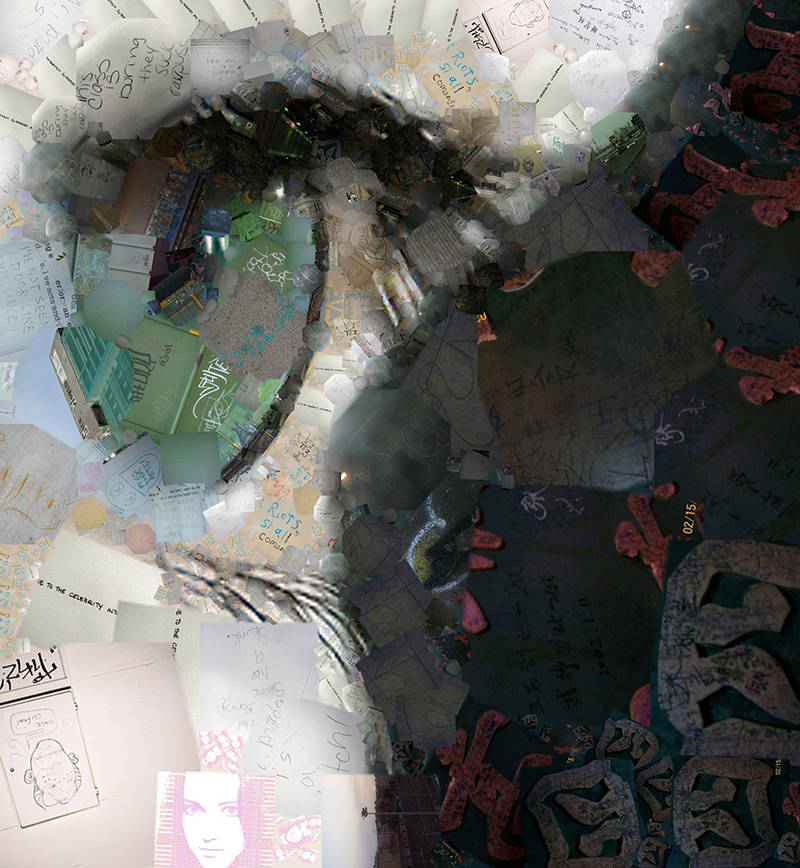\r\nFigure 1: Fractal Mosaic created with graffiti image set (best viewed [large](https://raw.github.com/s-ben/Fractal-Mosaics/gh-pages/images/eye_mosaic_flickr_large.jpg?login=s-ben&token=87b09134a5f66d314547e419299a65b7)\r\n\r\nFigure 2 shows three traditional photomosaics created using the same image set and target image. \r\n\r\n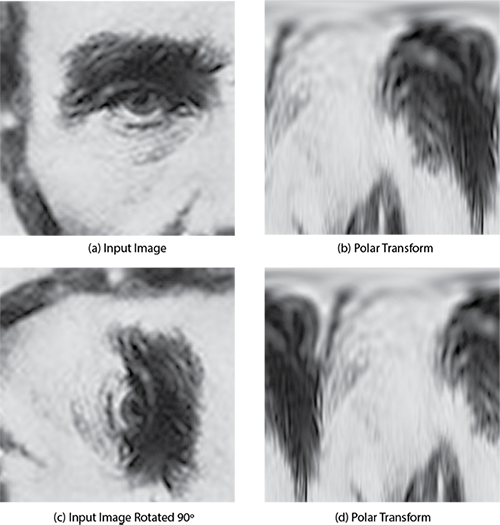\r\nFigure 2: Traditional Photomosaics using large tiles (left), medium sized tiles (middle), and small tiles (right)\r\n\r\nAs can be seen, using large tiles (left), finer details are lost. Using small tiles (right), we capture target image details, but can’t see individual image detail. Using medium size tiles (middle), we get a compromise between the two. Fractal Mosaics aims to create mosaics that capture both target image details and individual image details, in an aesthetically interesting way.\r\n\r\nBy allowing for arbitrary placement, rotation, and scaling of the “library images” (images making up the mosaic), there are an many more possible matches to evaluate. This allows for larger, often more aesthetically interesting matches than possible with traditional photomosaics. However, searching such a large solution space on a personal computer presents a challenging problem. This “paper” presents my solution to this problem (two years worth of unpaid work...). It explains the algorithm in depth for those wishing to hack the Matlab code. It should also aid those using the code to create mosaics, as understanding how the algorithm works will help tweak parameters that shape mosaic output.\r\n\r\n# Introduction / Problem Statement\r\n\r\nIn a traditional photomosaic, the number of possible matches is large but still easily manageable on a modern PC. The number of possible matches is simply the number of “tiles” (square areas in the target image) times the number of library images. For each tile, a similarity metric is calculated (root mean squared (rms) error, typically) for every library image. The library image with the smallest rms error is placed in the mosaic.\r\n\r\nIn a Fractal Mosaic, the number of possible possible matches is effectively infinite. For example, let’s say we use 5,000 library images, a 3072 x 1024 pixel target image, and do the following fairly rough quantization of the possible translations, rotations, and scalings: \r\n\r\n* 2 degree rotations (180 possible rotations)\r\n* Every fifth pixel is a possible placement location (629,145 possible translations)\r\n* 50 possible scaling values\r\n\r\nThis gives us (180 rotations) x (629,145 translations) x (50 scalings) x (5,000 library images) = 28,311,525,000,000 possible matches to search. Or ~28 trillion matches. Obviously, a brute force search is not feasible (I tried).\r\n\r\nFractal Mosaics tackles this complexity with three main strategies. One strategy is inherent in the “Log-polar” image registration algorithm at the core of Fractal Mosaics. This algorithm uses